
Florida DEP, environmentalists back oil-drilling permit rejection
The state is asking an appeals court to reject arguments from a company wanting to drill for oil along Florida’s Apalachicola River

TALLAHASSEE, Florida — The state is asking an appeals court to reject arguments from a company wanting to drill an exploratory oil well along the Apalachicola River.
In a court brief filed this week, the Florida Department of Environmental Protection, which recommended permit approval in 2024, argued that a judge’s recommendation to kill the permit application should be upheld.
Clearwater Land & Minerals of Shreveport, Louisiana, had argued the state judge was improperly tracking legislation that banned drilling and had been signed by Gov. Ron DeSantis in 2025. But DEP said the “stray footnote” in the judge’s recommended order was not a finding of fact that held legal weight.
Furthermore, the Apalachicola Riverkeeper, also in a brief filed this week, said the argument “is a thin reed on which to base Clearwater’s claim that the entire proceeding is ‘prejudicially tainted.’”
The proposed state permit in 2024 to allow drilling 1.5 miles from the Apalachicola River set off a political firestorm that included a protest with hundreds of people outside DEP headquarters. Critics said drilling could threaten wildlife along the Apalachicola River and the seafood industry at Apalachicola Bay. DEP previously had permitted drilling at the site for another company in 2019.
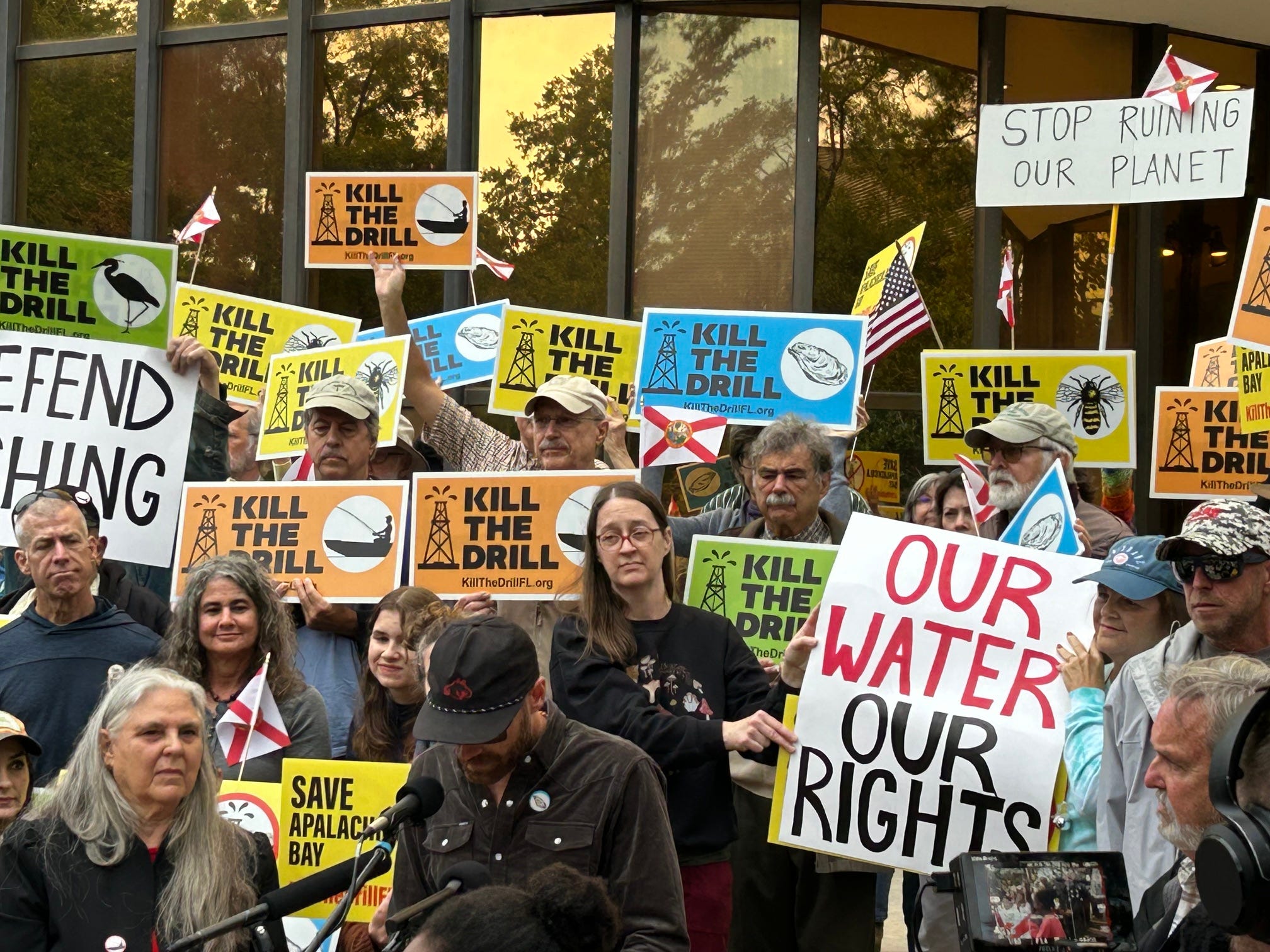
Drilling opponents rallied outside the DEP headquarters on Dec. 9, 2024. Photo copyrighted by Bruce Ritchie.
Administrative Law Judge Lawrence P. Stevenson recommended DEP ultimately deny the proposed permit, saying a spill at the Calhoun County site would have “catastrophic consequences” for surrounding streams and swamps.
He also said Clearwater had failed to establish the likelihood that oil would be found below the site.
Stevenson said the company prepared an economic analysis based on the prospect of drilling seven wells in the area to look for oil. But then DEP and the company wanted to limit the scope of the environmental review only to the footprint of the single well on the drilling site.
The Legislature unanimously passed House Bill 1143 after the geographic scope of the drilling ban was restricted to counties along the Apalachicola River.
In an initial brief filed in February, Clearwater argued the legislation improperly led Stevenson to consider the possible wider effects of oil exploration beyond the proposed drilling site.
Clearwater asked the First District Court of Appeal to toss out Florida’s permit denial to make way for a possible new lawsuit for a “property rights takings” claim.
But Apalachicola Riverkeeper said this week the company’s attempts “to spin a tale of prejudice from a mere footnote” were an improper ploy to have the appeals court reweigh the evidence.
The group also supported the judge’s claim that Clearwater had failed to establish the likelihood that oil would be found. Sixty-three wells have been drilled in Calhoun and the surrounding counties, the group said, and none struck oil.
And Apalachicola Riverkeeper reiterated Stevenson’s concern that the drilling site could be cut off by floodwaters.
“In conclusion, Clearwater essentially argues that a site can be surrounded by the most sensitive environments, but as long as the drilling pad itself is in a previously impacted area or uplands, then everything that surrounds it is irrelevant,” the group said.
The group said Stevenson had rejected the “exceedingly narrow” argument, as should the appeals court.